I wish there was a filter that could be applied to anything online connected to current events that would remove from my sight all articles based on conjecture: “scientists may have discovered…”, “Democrats might do…”, “it’s possible that Trump’s actions might lead to…” and so forth. Which I’m convinced would reduce most new sites to a readable scale. I’ll get my speculative fiction from novelists.
Recent Posts
I propose a change in the way that journalists report on movies. Instead of telling us how much was made at the box office on opening weekend ( “Project Hail Mary made $80M at the box office on …
Trump might want to remember how Pearl Harbor turned out for Japan.
In January, my a1c spiked, and my doctor diagnosed me as diabetic and prescribed Metformin. I tried it, and it was working, but my stomach couldn’t take it. I then negotiated a two-month attempt …
“For the intellectual an exilic displacement means being liberated from the usual career, in which ‘doing well’ and following in time-honored footsteps are the main milestones. Exile means that you are always going to be marginal, and that what you do as an intellectual has to be made up because you cannot follow a prescribed path. If you can experience that fate not as a deprivation and as something to be bewailed, but as a sort of freedom, a process of discovery in which you do things according to your own pattern, as various interests seize your attention, and as the particular goal you set yourself dictates: that is a unique pleasure.”
– Edward Said, Representations of the Intellectual
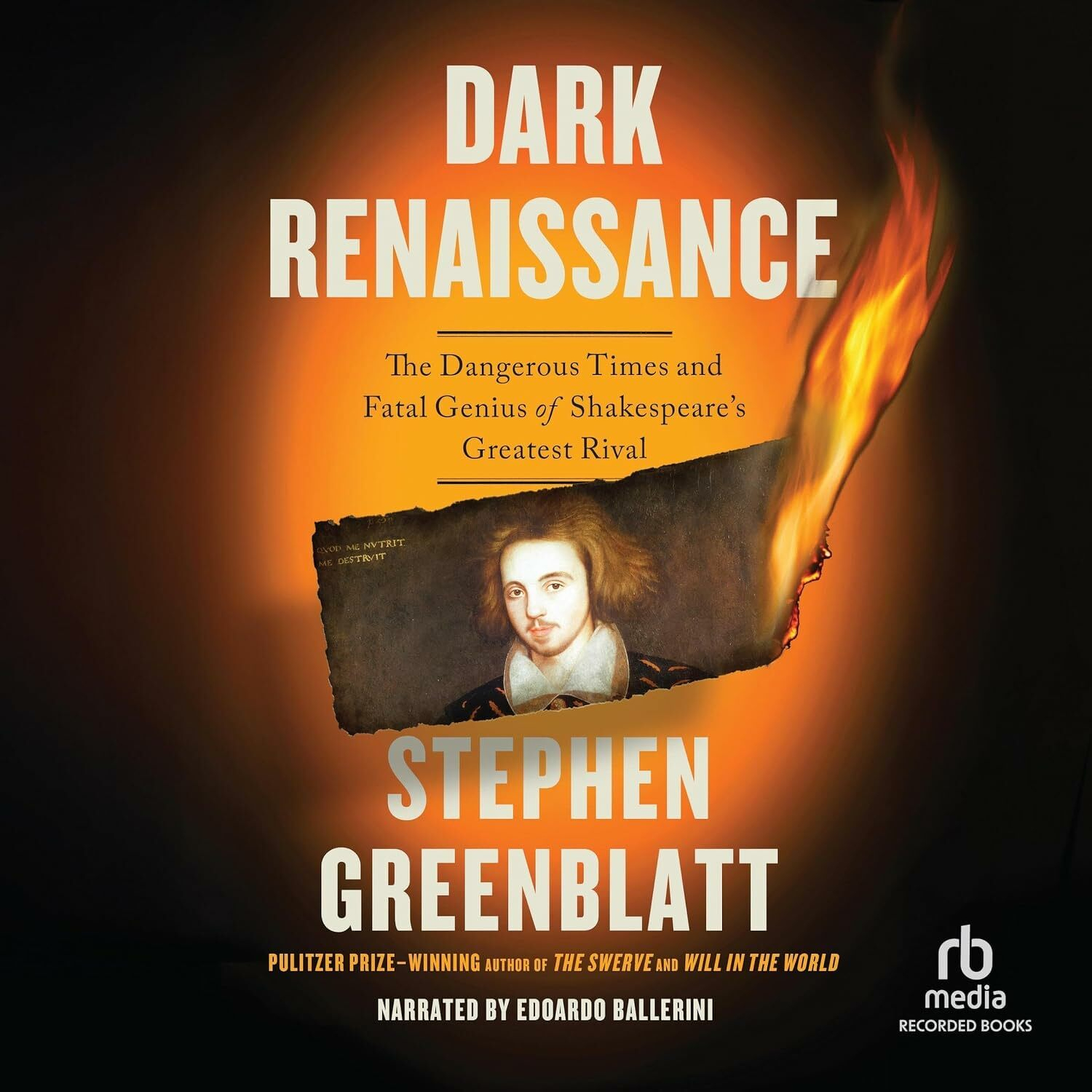
Finished reading: Dark Renaissance: The Dangerous Times and Fatal Genius of Shakespeare’s Greatest Rival by Stephen Greenblatt 📚
As a fan of Stephen Greenblatt’s 2004 bestseller Will in the World: How Shakespeare Became Shakespeare, I eagerly bought Greenblatt’s latest book, Dark Renaissance. This time, instead of Shakespeare, Greenblatt describes the tempestuous life of Elizabethan playwright Christopher Marlowe, author of several masterpieces including Doctor Faustus, who was murdered at the age of 29 in suspicious circumstances. While details about Marlowe’s life and violent death are scant, Greenblatt creates a compelling and vivid portrait of Marlowe’s brilliant and all-too-short life by vividly describing the historical, political, and especially religious context of Elizabethan England in the latter decades of the 16th century. To describe those years as “dangerous times” seems an understatement, especially pertaining to the struggle over Catholicism and Anglicanism, and there is evidence that Marlowe was right in the middle of it, serving as a spy for the crown while also involved promoting atheism – dangerous indeed. Greenblatt is not averse to conjecture when necessary to fill in details, but when he does so, it was always used as a way of bringing a moment or issue to life, and I never felt that he was overreaching. The result is as close to a page-turner as you’re likely to find in a book of non-fiction history, and I recommend it without reservation.
“A calm and modest life brings more happiness than the pursuit of success combined with constant restlessness”
–Albert Einstein
The unintended irony of this book’s title made me laugh…
American Intellectual History: A Very Short Introduction
Freud: How did I get here?
Jung: What story am I a part of / what role am I playing?
Adler: How do I change?
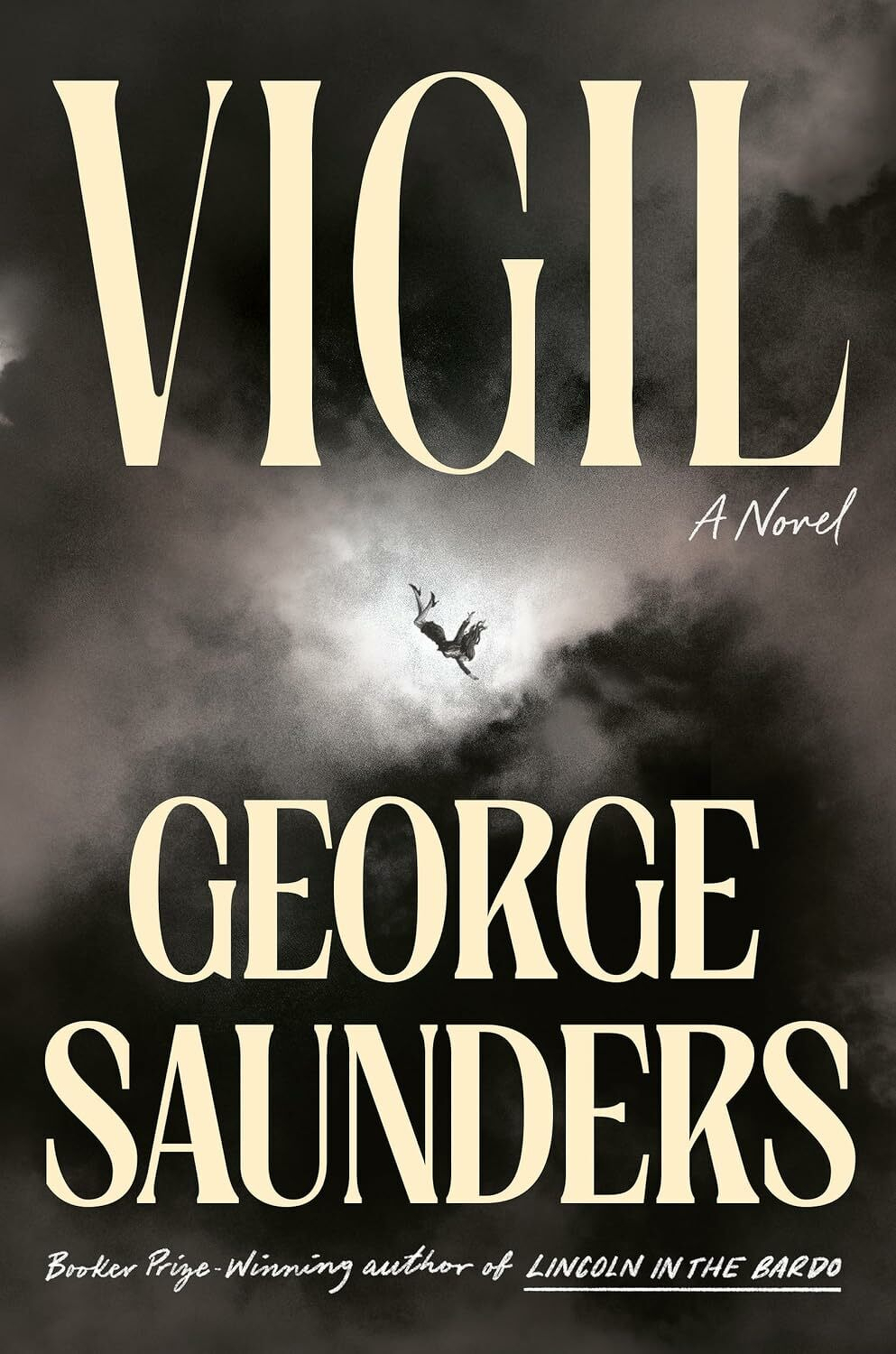
Finished reading: Vigil by George Saunders 📚
I was blown away by Saunders’s Lincoln in the Bardo. So when I read that he had a new novel out that had a similar metaphysical/purgatorial (is that a word?) setting, I grabbed it and settled down to read. Reading Lincoln in the Bardo required a period of learning how to read it, but once I did (for me, I made a connection to the format of Ken Burns’s The Civil War) I did, the tale spun out in a wonderful mix of sadness and hilarity. When I started Vigil, I suspected it would be a similar experience.
The first scene, in which the narrator, the angel previously known as Jill “Doll” Blaine, is plummeting happily toward earth and landing head first on the asphalt, her head and shoulders piercing the ground, leaving her “bicycling energetically” until she can right herself. “Aha!,” I thought knowingly, “sort of like the start of Salman Rushdie’s Satanic Verses – INteresting… " And truth be told, I wasn’t entirely wrong in my gut response. The novel has a similar comic anarchy to most of Rushdie’s work.
The plot involves the attempts of the Angel formerly known as Jill to get an oil magnate on the brink of death to repent of the lies he told and admit that damage he’d done to the climatic fate of the earth. Somewhere, Saunders admitted in an interview that one of his favorite novels if Dickens’s A Christmas Carol, and the parallel is a good one, if the tone is far more madcap. Madcap, yet punctuated by moments of sadness and longing.
I finished the book in two large gulps over the course of two days, and when I put it down, I thought, “Well, I need to think about this a bit more,” and I have, but haven’t made a great deal of progress. The thing I keep getting stuck on is what seems to me to be a metaphysical or theological confusion at the center of the action. Our angelic narrator several times makes it very clear that human beings live within an entirely deterministic universe. We are born with certain personal characteristics, and once born, those characteristics encounter experiences about which we have no control that reinforces as brings to the fore our innate characteristics. I was reminded of Robert M. Sapolsky’s recent book, Determined: A Science of Life without Free Will, which makes a similar argument. And yet, as Sapolsky argues, “it’s sometimes impossible to uncouple from our zeal to judge people, including ourselves.” Which seems to be the case in Vigil, since most of the novel’s action involves, well, our zeal to judge the oil magnate and our desire to get him to judge himself. This is especially true of the other primary angelic visitor, the spirit of Etienne Lenoir, the inventor of the combustion engine, who apparently is spending eternity trying to make amends for the effects of his invention by exacting deathbed repentance from other climate-destroying entrepreneurs, including our oil magnate.
So when I finished, I wasn’t sure whether there was any coherence between the immanent world and the transcendent world. In the immanent world, we have no choice about who we are and what we do, and yet when we die, we are held accountable for our actions nonetheless. As I write this, it occurs to me that perhaps the novel’s purpose is to illustrate, in a comic fashion, the tragedy of being a human being.
For those not as focused on meaning and interpretation, Saunders’s novel is a fast and funny read with many laugh-out-loud moments of slapstick and irony, as well as poignant ones in which the dead and dying look longingly at the beauty of the world and our experiences in it. (The latter reminded me of Act 3 of Thornton Wilder’s Our Town, in which the recently-dead Emily revisits a normal day from her youth and despairs at how unaware human beings are of the wonder of small things.)
Would I recommend Vigil? Yes, but I would warn fans of Lincoln in the Bardo that Saunders is going to give you an entirely different experience than you had with that novel.