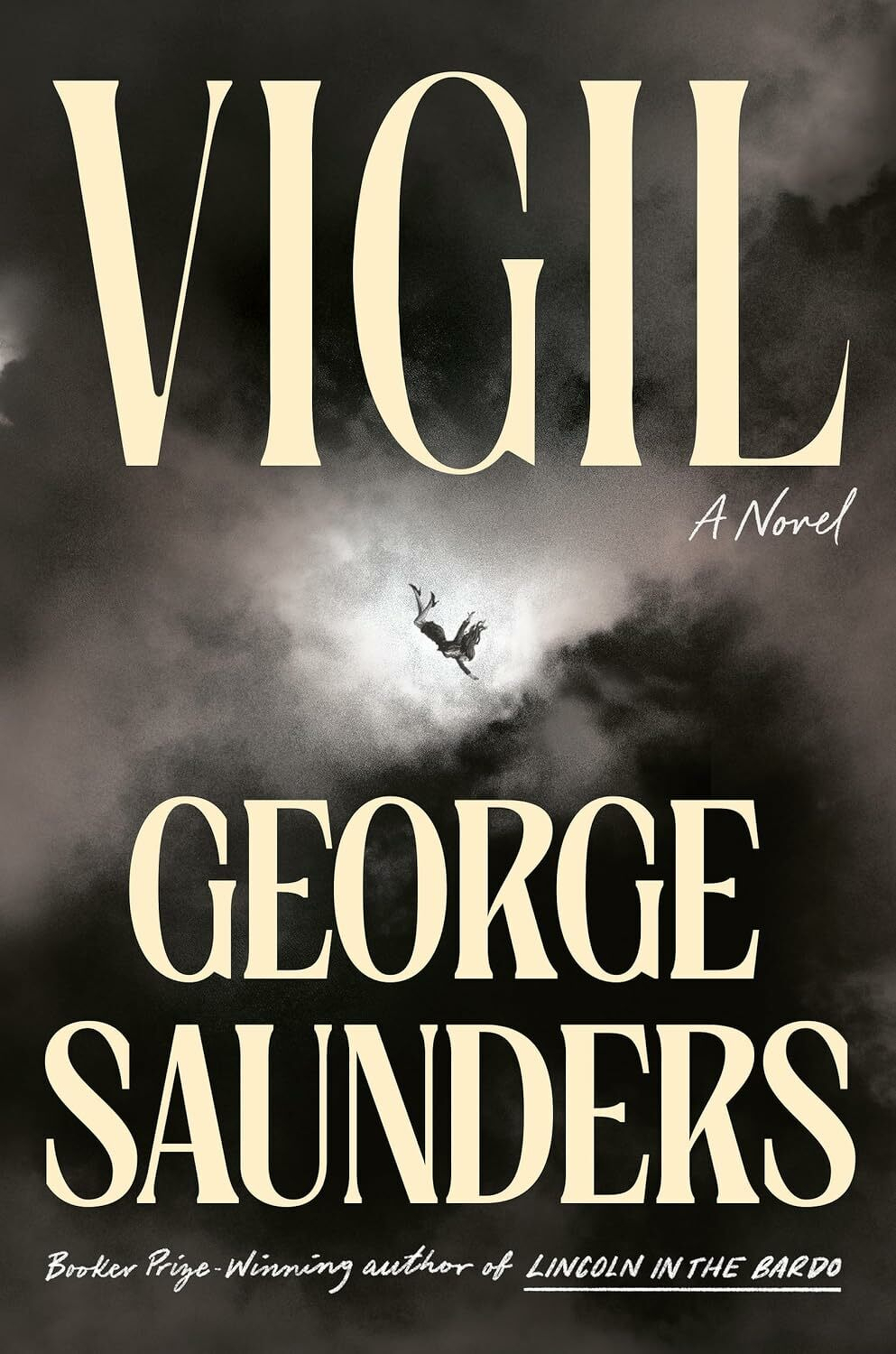
Finished reading: Vigil by George Saunders 📚
I was blown away by Saunders’s Lincoln in the Bardo. So when I read that he had a new novel out that had a similar metaphysical/purgatorial (is that a word?) setting, I grabbed it and settled down to read. Reading Lincoln in the Bardo required a period of learning how to read it, but once I did (for me, I made a connection to the format of Ken Burns’s The Civil War) I did, the tale spun out in a wonderful mix of sadness and hilarity. When I started Vigil, I suspected it would be a similar experience.
The first scene, in which the narrator, the angel previously known as Jill “Doll” Blaine, is plummeting happily toward earth and landing head first on the asphalt, her head and shoulders piercing the ground, leaving her “bicycling energetically” until she can right herself. “Aha!,” I thought knowingly, “sort of like the start of Salman Rushdie’s Satanic Verses – INteresting… " And truth be told, I wasn’t entirely wrong in my gut response. The novel has a similar comic anarchy to most of Rushdie’s work.
The plot involves the attempts of the Angel formerly known as Jill to get an oil magnate on the brink of death to repent of the lies he told and admit that damage he’d done to the climatic fate of the earth. Somewhere, Saunders admitted in an interview that one of his favorite novels if Dickens’s A Christmas Carol, and the parallel is a good one, if the tone is far more madcap. Madcap, yet punctuated by moments of sadness and longing.
I finished the book in two large gulps over the course of two days, and when I put it down, I thought, “Well, I need to think about this a bit more,” and I have, but haven’t made a great deal of progress. The thing I keep getting stuck on is what seems to me to be a metaphysical or theological confusion at the center of the action. Our angelic narrator several times makes it very clear that human beings live within an entirely deterministic universe. We are born with certain personal characteristics, and once born, those characteristics encounter experiences about which we have no control that reinforces as brings to the fore our innate characteristics. I was reminded of Robert M. Sapolsky’s recent book, Determined: A Science of Life without Free Will, which makes a similar argument. And yet, as Sapolsky argues, “it’s sometimes impossible to uncouple from our zeal to judge people, including ourselves.” Which seems to be the case in Vigil, since most of the novel’s action involves, well, our zeal to judge the oil magnate and our desire to get him to judge himself. This is especially true of the other primary angelic visitor, the spirit of Etienne Lenoir, the inventor of the combustion engine, who apparently is spending eternity trying to make amends for the effects of his invention by exacting deathbed repentance from other climate-destroying entrepreneurs, including our oil magnate.
So when I finished, I wasn’t sure whether there was any coherence between the immanent world and the transcendent world. In the immanent world, we have no choice about who we are and what we do, and yet when we die, we are held accountable for our actions nonetheless. As I write this, it occurs to me that perhaps the novel’s purpose is to illustrate, in a comic fashion, the tragedy of being a human being.
For those not as focused on meaning and interpretation, Saunders’s novel is a fast and funny read with many laugh-out-loud moments of slapstick and irony, as well as poignant ones in which the dead and dying look longingly at the beauty of the world and our experiences in it. (The latter reminded me of Act 3 of Thornton Wilder’s Our Town, in which the recently-dead Emily revisits a normal day from her youth and despairs at how unaware human beings are of the wonder of small things.)
Would I recommend Vigil? Yes, but I would warn fans of Lincoln in the Bardo that Saunders is going to give you an entirely different experience than you had with that novel.