“Along with Joseph Addison, Shaftesbury paved the way for a new approach to English writing, pioneering a kind of polite and entertaining essay aimed at the educated classes.” – A Philosophy of Beauty by Michael B. Gill

Have we ever had anything approaching such a tradition in America?

Wow. I just spent 3 hours writing something that could have been created by 3 monkeys pounding on a typewriter for 30 minutes.

A Different Vision of Education

In many ways, I think this quotation is what higher education in the arts ought to be: recognizing talent, and patiently helping it to emerge. I used to tell my students that I would consider myself a failure if any of them became little versions of me. I was here, I said, to help them fully become themselves. The task isn’t “to teach them how to do it,” it’s “to teach them how THEY do it.”

“There’s a beautiful passage Black Lives Matter cofounder Alicia Garza wrote in the wake of the 2016 election: This is a moment for all of us to remember who we were when we stepped into the movement—to remember the organizers who were patient with us, who disagreed with us and yet stayed connected, who smiled knowingly when our self-righteousness consumed us. Building a movement requires reaching out beyond the people who agree with you. I remember who I was before I gave my life to the movement. Someone was patient with me. Someone saw that I had something to contribute. Someone stuck with me. Someone did the work to increase my commitment. Someone taught me how to be accountable. Someone opened my eyes to the root causes of the problems we face. Someone pushed me to call forward my vision for the future. Someone trained me to bring other people who are looking for a movement into one.”

Whose Story Is This? Rebecca Solnit

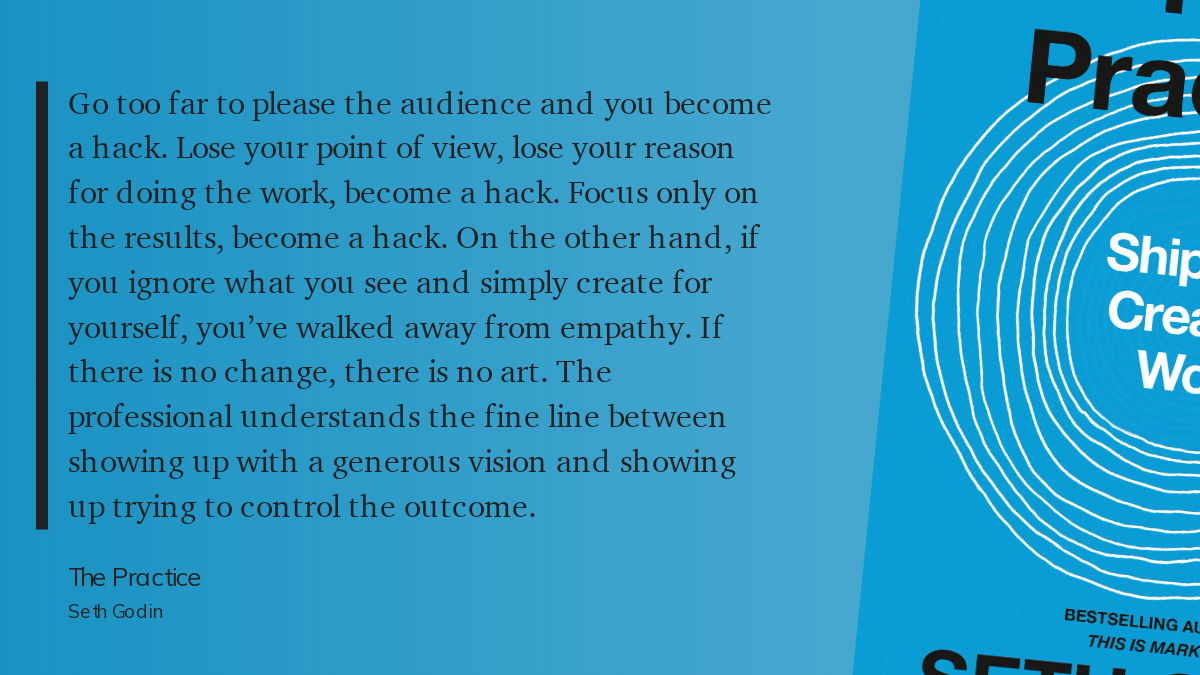
A fine line, but the best playwrights and artists understand.

Where Are Our Prophets?

“…things do seem to have changed in literary fiction, and you don’t have to go back far to see it. The year? 2006. The people? Those the novelist Garth Risk Hallberg called the “Conversazioni group” for their joint attendance of a 2006 literary festival in Italy (called Le Conversazioni), interesting fragments of which have ended up on YouTube. The members of the group were Zadie Smith, Jonathan Franzen, David Foster Wallace, and Jeffrey Eugenides. All were in their thirties or forties: Smith (31), Franzen (47), Wallace (43), Eugenides (46). All were public-facing artists, and their debates were on the form and function of writing itself: who could forget the term “hysterical realism” or “contract vs. status” novels?”

Erik Hoel, “How the MFA Swallowed Literature: On the Total World Domination of Workshopped Fiction

The complaints in this excellent article echo that about literary criticism as well, and I suspect there are similar articles about the other arts as well.

But what I find interesting is, in the midst of a lamentation about the deadening effect of the MFA on literary fiction is this seeming longing for, well, a conversation like the one in Italy, like the public-facing conversations had by Franzen, Smith, Wallace, and Eugenides.

I have certainly felt the same about theater. Where are the artists who are discussing ideas, values, principles? Where are the manifestos? They seem missing, and I think it is because large theaters don’t want anyone to rock the boat, protesting that it’s hard enough to keep things afloat without dealing with Big Ideas and rabble rousers. What we have instead are kvetchers.

The theologian Walter Breuggemann, in his classic book The Prophetic Imagination said there were two elements of prophetic speech: strong criticism of the status quo, and an inspiring vision of a new world that is possible. Theater seems to have only the first part; we’re in desperate need of second.

Definition: Anti-Intellectualism

“The common strain that binds together the attitudes and ideas which I call anti-intellectual is a resentment and suspicion of the life of the mind and of those who are considered to represent it; and a disposition constantly to minimize the value of that life.”

Richard Hofstadter, Anti-Intellectualism in American Life

“The theater’s rich intellectual inheritance serves as a buffer to society’s recrudescent stupidity.”

Charles McNulty, LA Times

I’m thinking about having a t-shirt made emblazoned with “A Buffer to Society’s Recrudescent Stupidity.” Perhaps with, in parenthesis: “look it up”

Alan Jacobs on The Work Itself

It seems to be an Alan Jacobs day! His post called “The Work Itself,” about the difference between being an influencer and doing a job, is excellent. For me, it is coinciding with my current reading of Matthew B Crawford’s Shop Class as Soulcraft and The World Beyond Your Head, _as well as Richard Sennett’s The Craftsman.

For the artist, the work as an end in itself ought to be your entire focus. Yet in theater and film, too much attention is given by professors and the media to “success” defined by fame and fortune, both of which are worthless to a true artist. Do the work.

Adam Smith on Vanity

[T]he desire of doing what is honourable and noble, of rendering ourselves the proper objects of esteem and approbation, cannot, with any propriety, be called vanity. Even the love of well grounded fame and reputation, the desire of acquiring esteem by what is really estimable, does not deserve that name. The first is the love of virtue, the noblest and the best passion of human nature. The second is the love of true glory, a passion inferior, no doubt, to the former, but which in dignity appears to come immediately after it. He is guilty of vanity who desires praise for qualities which are either not praiseworthy in any degree, or not in that degree in which he expects to be praised for them; who sets his character upon the frivolous ornaments of dress and equipage, or upon the equally frivolous accomplishments of ordinary behaviour. He is guilty of vanity who desires praise for what, indeed, very well deserves it, but what he perfectly knows does not belong to him. The empty coxcomb who gives himself airs of importance which he has no title to; the silly liar who assumes the merit of adventures which never happened; the foolish plagiary who gives himself out for the author of what he has no pretensions to, are properly accused of this passion. He too is said to be guilty of vanity who is not contented with the silent sentiments of esteem and approbation; who seems to be fonder of their noisy expressions and acclamations than of the sentiments themselves; who is never satisfied but when his own praises are ringing in his ears, and who solicits, with the most anxious importunity, all external marks of respect; is fond of titles, of compliments, of being visited, of being attended, of being taken notice of in public places with the appearance of deference and attention. This frivolous passion is altogether different from either of the two former, and is the passion of the lowest and the least of mankind, as they are of the noblest and the greatest.

Does that last part remind you of anyone particular?