Derek Thompson and Ezra Klein may be right about some things in Abundance, but their belief in nuclear power is not one of them. Michael Shuman on Substack does a great job dismantling their arguments in “Nuclear ‘Abundance’ is Bunk.” McKibben and Shuman are right: the future is solar and wind.
Here’s a short film called “How an Abandoned Shoe Shop Became a Sanctuary for Culture and Connection”." It’s about Dougald Hine and his wife, Anna Björkman, who have …
After I finished writing about Paul Kingsnorth’s Against the Machine: On the Unmaking of Humanity (here and here), I found I wanted to follow some of the topics that had caught my curiosity as a …
In the desert
I saw a creature, naked, bestial,
Who, squatting upon the ground,
Held his heart in his hands,
And ate of it.
I said, “Is it good, friend?”
“It is bitter—bitter,” he answered;
“But I like it “Because it is bitter, “And because it is my heart.”
Stephen Crane, In the Desert
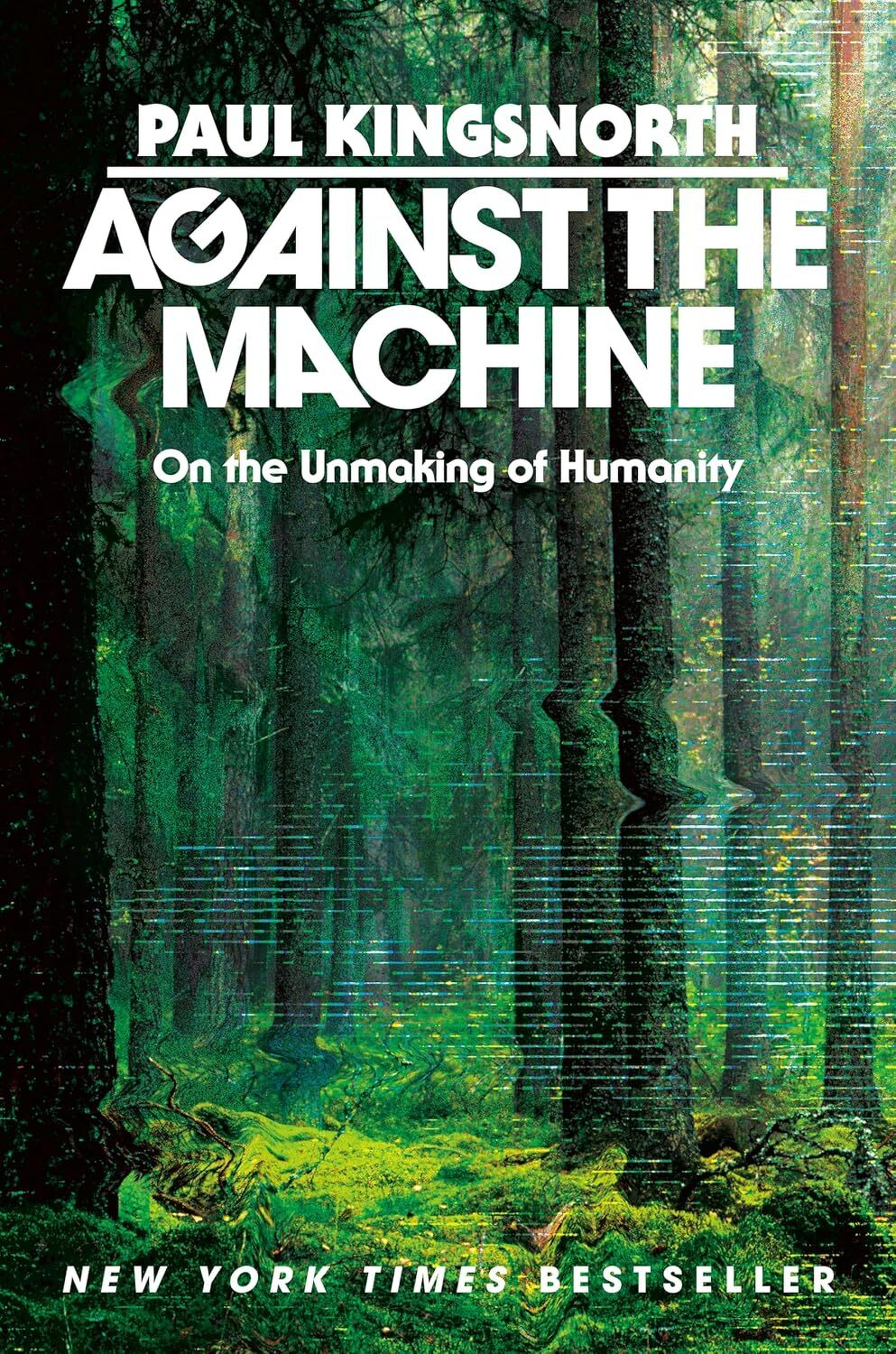
A few days ago, I finished reading Paul Kingsnorth’s Against the Machine, a compelling and powerfully written rejection of, basically, everything introduced into our culture since the advent of the Industrial Revolution.
There is a prophetic streak in Kingsnorth that gives his writing a propulsive energy that is simultaneously bracing and abrasive that seems to have been present since at least his 2009 “Dark Mountain Manifesto,” co-written with Dougald Hine. “There is a fall coming,” they wrote.
“We live in an age in which familiar restraints are being kicked away, and foundations snatched from under us. After a quarter century of complacency, in which we were invited to believe in bubbles that would never burst, prices that would never fall, the end of history, the crude repackaging of the triumphalism of Conrad’s Victorian twilight – Hubris has been introduced to Nemesis. Now a familiar human story is being played out. It is the story of an empire corroding from within. It is the story of a people who believed, for a long time, that their actions did not have consequences. It is the story of how that people will cope with the crumbling of their own myth. It is our story.
Seventeen years later, their observations are, if anything, truer than ever, and as I read Against the Machine, I inwardly applauded Kingsnorth’s ability to condemn modern life with vigor and memorable imagery. It is a style of writing that I have encountered in another writer whose insights I admire, Chris Hedges, whose pit-of-hell despair I mostly find exhausting and debilitating. Which, in turn, leads me to question myself. Am I just an intellectual coward unwilling to look reality square in the face? Or is there something else preventing me from shouting “amen” after Kingsnorth swings his rhetorical sledgehammer at 21st-century society?
As someone who used as an epigraph on his blog Buckminster Fuller’s famous quotation, “You never change things by fighting the existing reality. To change something, build a new model that makes the existing model obsolete,” I admire that Kingsnorth walks his talk. He rejects much of modern technology, and consequently has withdrawn to a small homestead in rural Ireland where he does his best to live according to his anti-technological values. And yet, he doesn’t seem to be able to describe the joys and challenges of his chosen life in a way that might inspire others to follow his example. He seems much more comfortable railing “against the machine” than singing “for the earth.”
In her brilliant essay on Homer’s Iliad, the 20th-century French philosopher Simone Weil, to whom Kingsnorth alludes to admiringly more than once in Against the Machine, wrote about the concept of “force” that she finds at the center of the epic’s conflict. Weil defines force as “that x that turns anybody who is subjected to it into a thing. Exercised to the limit, it turns man into a thing in the most literal sense: it makes a corpse out of him.” She goes on, “Force employed by man, force that enslaves man, force before which man’s flesh shrinks away. In this work, at all times, the human spirit is shown as modified by its relations with force, as swept away, blinded, by the very force it imagined it could handle, as deformed by the weight of the force it submits to.” This could easily serve as a summary of Kingsnorth’s book. His focus is almost completely oppositional.
An oppositional focus tends to see society as being aggressive, as forcing things upon us. You can see this in the words he regularly uses to describe modern civilization. Our culture is “under attack” from the “Black Ships of the globalized economy,” and our very humanity is threatened by the advance of The Machine (always capitalized). we are “entirely enslaved,” both by the left and by global capitalism, which are"engines for destroying" customary ways of living." They even want to take away our fireplaces, which is the “latest blow against the home as the centre of the universe.” If you lose your fireplace, “you literally lose your focus as a culture.” Indeed, “Strip the last remaining fires from the last remaining hearths, and you are one step closer to what is perhaps the ultimate ambition of the Machine: the abolition of home…The home must go, so that the Machine might live.” Further: “any blow struck for the survival or the revival of the home and the family is an act of resistance and of rebuilding…The home can be a friction against the Machine. If this is a war, it is long past time to begin fighting back.” Electricity is an enemy. “D. H. Lawrence once said that the world changed forever when the first electric bulb was switched on. Today those bulbs obscure the very stars, and we cannot take our eyes off the screens.” Indeed, “the sacred and the digital not only don’t mix, but are fatal to each other.” Referencing his previous activisim in the movement against climate change, he says “Older, crustier greenies like me, labouring under the yoke of a pre-modern sensibility which makes us reluctant to eat the [vat-grown] sludge [for breakfast] and live in the pod…” Finally, “What Progress wants,” he asserts, “is the end of transcendance.”
I could keep this up for much longer, but you get the picture: Kingsnorth’s vision is eschatological.
To engage in prophetic imagination, which seems to be Kingsnorth’s intention, usually does involve a vivid description of the end times, or at least the end of a regime. However, according to Walter Brueggemann’s Prophetic Imagination, probably one of the most influential books on the subject, there are two aspects of prophetic speech that both must be present. The first we might call the “descendant function,” which describes things that exist but ought not to. Kingsnorth has this one down cold. It’s the “ascendent function,” the description of things that do not exist but should, where Kingsnorth is weak. He has no strong vision for a possible future.
At best, his vision can best be described as being “free” of all the negative things he’d previously described in gruesome detail: free of cell phones, free of electricity, free of the global economy, free of the internet (although he admit that he must interact with that in order to get his work distributed, which is totally understandable), free of trans people (yeah, that chapter I find deeply offensive), in other words, well, free of The Machine. But that’s a subtraction story, not a vision.
The result of Kingsnorth’s book, even if one agrees (as I do) with many of his observations, is to leave one paralyzed in a defensive crouch and shaking one’s fist at the heavens in bitter despair with no vision of how one is to live other than Not That, which he renames “radical reaction.” And I think that is a refusal of prophetic responsibility. At the very least, he should help us grieve.
Says Brueggemann, “I believe that the proper idiom for the prophet in cutting through the royal numbness and denial is the language of grief, the rhetoric that engages the community in mourning for a funeral they do not want to admit. It is indeed their own funeral. I have been increasingly impressed with the capacity of the prophet to use the language of lament and the symbolic creation of a death scene as a way of bringing to reality what the king must see and will not. And I believe that grief and mourning, that crying in pathos, is the ultimate form of criticism, for it announces the sure end of the whole royal arrangement.” Kingsnorth’s bitterness prevents lamentation, both his or ours.
In the face of despair, Brueggemann suggests three tasks for the prophet to undertake:
-
to offer of symbols “that are adequate to contradict a situation of hopelessness in which newness is unthinkable”
-
“to bring to public expression those very hopes and yearnings that have been denied so long and suppressed so deeply that we no longer know they are there
-
to speak metaphorically about hope but concretely about “the real newness that comes to us and redefines our situation”
He does this through what Brueggemann calls the “language of amazement” which, is the language of hope, and is based on “the refusal to accept the reading of reality which is the majority opinion.”
The language of hope and amazement is lyrical, metaphoric, not “explanatory and scientifically argumentative;” it must touch “the hopeless person at many different points.” And herein lies the tragedy of Paul Kingsnorth, I think.
Fewer than twenty years ago, “The Dark Mountain Manifesto” was filled with the language of amazement and hope, of lyricism and metaphor. There are long segments drawn from the poetry of Robinson Jeffers, quotes from Emerson, Joseph Conrad, Bertrand Russell, Philip Larkin, John Berger, to name just a few. “Our world is still shaped by stories,” they declare, rightly I believe, and while we “find ourselves, our ways of telling unbalanced, trapped inside a runaway narrative, headed for the worst kind of encounter with reality,” there is an alternative:
“In such a moment, writers, artists, poets and storytellers of all kinds have a critical role to play. Creativity remains the most uncontrollable of human forces: without it, the project of civilisation is inconceivable, yet no part of life remains so untamed and undomesticated. Words and images can change minds, hearts, even the course of history. Their makers shape the stories people carry through their lives, unearth old ones and breathe them back to life, add new twists, point to unexpected endings. It is time to pick up the threads and make the stories new, as they must always be made new, starting from where we are.
“Mainstream art in the West has long been about shock; about busting taboos, about Getting Noticed. This has gone on for so long that it has become common to assert that in these ironic, exhausted, post-everything times, there are no taboos left to bust. But there is one.
“The last taboo is the myth of civilisation.”
They go on, in words that sound like a call to action:
“We believe that artists – which is to us the most welcoming of words, taking under its wing writers of all kinds, painters, musicians, sculptors, poets, designers, creators, makers of things, dreamers of dreams – have a responsibility to begin the process of decoupling. We believe that, in the age of ecocide, the last taboo must be broken – and that only artists can do it…We believe that art must look over the edge, face the world that is coming with a steady eye, and rise to the challenge of ecocide with a challenge of its own: an artistic response to the crumbling of the empires of the mind.”
Now, seventeen years later, there are only furtive gestures in this direction to be found in Against the Machine. Instead of artists, Kingsnorth is now pointing toward philosophers, theologists, and cultural critics such as Paul the Apostle, G.K. Chesterton, René Guénon, Lewis Mumford, and Jacques Ellul. Oh, as always in books of this nature, Christopher Lasch. New Yorker writer Cal Revely-Calder fittingly and depressingly entitled his review of Kingsnorth’s book “A Dark Ecologist Warns Against Hope,” summarizing it as follows: “For years, Paul Kingsnorth was one of the most visible members of the green movement. Then he walked away from it. Now he wants us to walk away from everything else.” Wow.
Which leads me to echo, sadly and perhaps superficially, the minister of the iconic movie The Big Chill: where did Paul’s hope go? Perhaps the answer to my question is scattered throughout his books, essays, and novels written between 2009 and now, I don’t know. But if Against the Machine is Kingsnorth’s magnum opus, I’d say that, without hope, without a vision of the future that goes beyond “Run away!,” he runs the risk of being seen as an old man yelling at clouds.
Being a person living in 21st century America requires us to try to forge some sort of conscious system of beliefs regarding aspects of our hyper-capitalist culture. That might mean developing a set …
I haven’t been posting much lately, as I’ve been traveling and am now in Chicago helping my stepson.
A few brief thoughts. I’m reading Paul Kingsnorth’s Against the Machine in conjunction with Hartmut Rosa’s The Uncontrollability of the World" – many interesting echoes between the two books, and there are many others that probably should be added to the stew. [1] I’ve been a bit reluctant until now to wade into Against the Machine, as I found Kingsnorth’s Dark Mountain Project 2009 manifesto so extremely bleak that I’ve kept my distance. Obviously, Kingsnorth has been through many changes in his ideas over the course of almost two decades, but there is still a sort of sub-terranean rumble of despair that I find disturbing. Nevertheless, Kingsnorth references many of the writers that have been foundational for me – Schumacher, for instance – so I suspect his writing will be worthwhile.
While I have lived in cities many times – New York City twice, Minneapolis-St. Paul, Asheville – my preference is for small towns, so many of Kingsnorth’s touchstones resonate. I don’t know whether either Kingsnorth of Rosa have any connection with anarchism – I think Kingsnorth mentions David Graeber (I’m nowhere near completing Against the Machine yet) – but I have anarchistic, localistic, human scale tendencies. Anarchism makes us think that maybe the way things are set up might not be as “natural” as they are made out to be, and that, as David Graeber put it, “The ultimate hidden truth of the world is that it is something that we make, and could just as easily make differently,” which threatens to upset the applecart of our daily life.
I think Rosa’s concept of resonance provides a possible prescription in relation to Kingsnorth’s diagnosis of what ails us as a society, and so I intend to work my way backward from The Uncontrollability of the World to Resonance and finally Social Acceleration. Much of Rosa’s and Kingsnorth’s ideas seem to dovetail with many of the anti-technology, anti-social-media tendencies that I share with many people here on MB and elsewhere. Kingsnorth and Rosa both seem to give great importance to the power of story, which, as a theater historian and theorist, I am finding inspirational and stimulating.
David Graeber, in Fragments of an Anarchistic Anthropology, writes that anarchism is “a project, which sets out to begin creating the institutions of a new society ‘within the shell of the old,’ to expose, subvert, and undermine structures of domination but always, while doing so, proceeding in a democratic fashion, a manner which itself demonstrates those structures are unnecessary.” Or, as Buckminster Fuller famously said, “You never change things by fighting the existing reality. To change something, build a new model that makes the existing model obsolete.” My books Building a Sustainabe Theater and DIY Theater MFA are my attempts to describe what this might look like for theater.
[1] - For instance:
- Thinking in Systems by Donella H Meadows
- The Need for Roots by Simone Weil
- *Art and Technics (*and maybe The Myth of the Machine or his books about the City) by Lewis Mumford
- The Republic of Love by Martha Nussbaum
- Anything by David Graeber
All-In-One Washer-Dryer with Heat Pump Technology
Another thing I’ve been considering is getting an all-in-one washer-dryer combo. We currently have a reasonably new Energy Star washer and dryer …
Since my wife and I moved to Western Massachusetts in the summer of 2022, we’ve been working with Berkshire Community Action Council to make our house more sustainable as far as heating and electricity are concerned. We heat with an oil-fueled furnace which runs a steam radiator system that also provides our hot water.
Things we’ve done so far:
- Replaced all the windows in the house
- Fully insulated the attic and the downstairs walls
- Trinity Solar installed 15 solar panels on the roof. Our house faces due East and West, so 9 panels are on the east-facing roof, and 6 are on the west-facing roof
- Installed two ceiling fans, one in the main bedroom and the other in the living room
Through a BCAC program, we had been considering replacing the oil furnace with a heat pump system, but the rules for the program say that there can be no heat unit in the basement (where my wife has her weaving studio), and you can’t keep the oil furnace as backup heating source. Given the coldness of the winters here, and the challenge of our house’s floor plan (many smallish rooms), we recently decided to forgo the heat pump and stick with the oil furnace for the time being.
Our rooftop solar panels feed into the grid; we do not have any batteries. We pay aproximately $111.00 a month for the panels, which are on a 30-year loan. Our plan is to pay them off earlier.
Eight months out of the year – April through November – our solar panels generate more electricity than we use. We haven’t had to pay National Grid for electricity since the west-facing panels were installed in 2024. We’re currently carrying a $618 credit on our electric bill.
Our oil bill is about $2000 a year.
Some things I want to research (and will publish here):
- If we were to install electric heaters on walls throughout the house, could we run the oil furnace lower, thus using less oil and more of the electric credit? The goal would be to shift the heating to electric to use the credit being generated.
- Should we get at least one battery? We have very few outages, and so far (knock wood) they have been short-lived.
- Induction stove top?
- Because our hot water is created by the oil furnace, we have to leave it on all summer. Should we buy a heat pump water heater and have it installed? Or an on-demand water heater?
- Should we replace the washer and dryer (electric) with an all-in-one ventless washer/dryer and install it upstairs?
I’m certain other things will arise, including eventually replacing our aging cars with an EV (perhaps with the addition of more solar panels).
Here’s the starting point for the posts that fall under the More Sustainable tab:
What can I do, as an individual and without need of participation or permission of other people, to make my life more sustainable and more disconnected from what I consider most objectionable in our current culture?
Definition: For me, sustainable is not only ecologically sustainable, but economically sustainable, psychologically sustainable, and culturally enhancing.
Constraints
- I’m about to turn 68
- I have Type 2 Diabetes and high cholesterol
- I have a hinky back
- I live in a small town where an automobile is necessary
Assets
- My solar panels currently produce more electricity than I use
- Our house is well-insulated and all the windows are new
- Our house has a half acre lot
- I have steady retirement income that covers our needs
- My wife and I have simple tastes, and no desire to travel
- We have supportive and loving sons
- We own bikes
- We have a certain amount of money for capital purchases, but I need to shepherd it carefully for the future
Restraints
- I’m not willing to sacrifice quality of life — this is not a quest to become an ascetic
- I’m not trying to go off grid — the winters are simply too brutal here in Western Massachusetts, and I don’t want to work that hard
- I’m staying put and working with the assets that I have
- I’m not foregoing modern inventions
- I’m not looking for purity — if I can’t completely eliminate the need for something that I otherwise might find objectionable (for instance, Amazon or big box stores), I will settle for using them only when needed and without guilthttps://www.sloww.co/flywheel-jim-collins/
- I won’t let the Perfect be the enemy of the Good. Any move toward better is a net positive
Goals
- Reducing carbon footprint
- Reducing expenditures
Disclaimer
- I’m not going to feel like I’m a failure if I don’t single-handedly “solve” climate change or the evils of late-stage capitalism; I’m tired of not doing anything because I can’t do everything. I’m also not going to feel guilty over what others will, no doubt, see as my privilege. I am privileged in many ways: time, education, economic security, and many, many other things.
- I am not presenting any of this as a model of how things ought to be done; rather, it’s what I am trying to do in order to contribute, recognizing that mine is just one push on the flywheel.
- I’m publishing this to the internet for anyone who might benefit from my research, either through my successes or my failures. I am also publishing it in order to take advantage of any suggestions or constructive criticisms others might have.
- I’ll probably continue to alter this as I go.